Given the imperative of ecological, economic and social transition, the French Solid Waste Partnership (FSWP) is contributing to international discussions on what a circular economy could ultimately look like in 2050, both in France and around the world.
The purposes of the circular economy
In public debate, circular economy is often reduced to recycling. However, recent international work – in particular the ISO 59004 norm, adopted in 2024, which breaks down the “10R” principle* into 13 actions ordered according to the life cycle – shows that a complete circular economy begins well before recycling and continues well beyond it. Refusing and avoiding some products or uses, rethinking the needs, adapting production through eco-design, reducing resource consumption, reusing, repairing, reconditioning, remanufacturing, repurposing, recycling, recovering energy, and even recovering materials stored in historic landfill sites: these actions form a coherent scale where recycling and energy recovery are at the bottom, once all the levers of reduction, moderation, sustainability, reuse and repair have been activated.
These coordinated actions only make sense when viewed in the context of the three objectives of circular economy: to reduce environmental and health impacts, to maintain an economy that creates value and jobs, and to ensure our societies’ resource sovereignty and resilience.
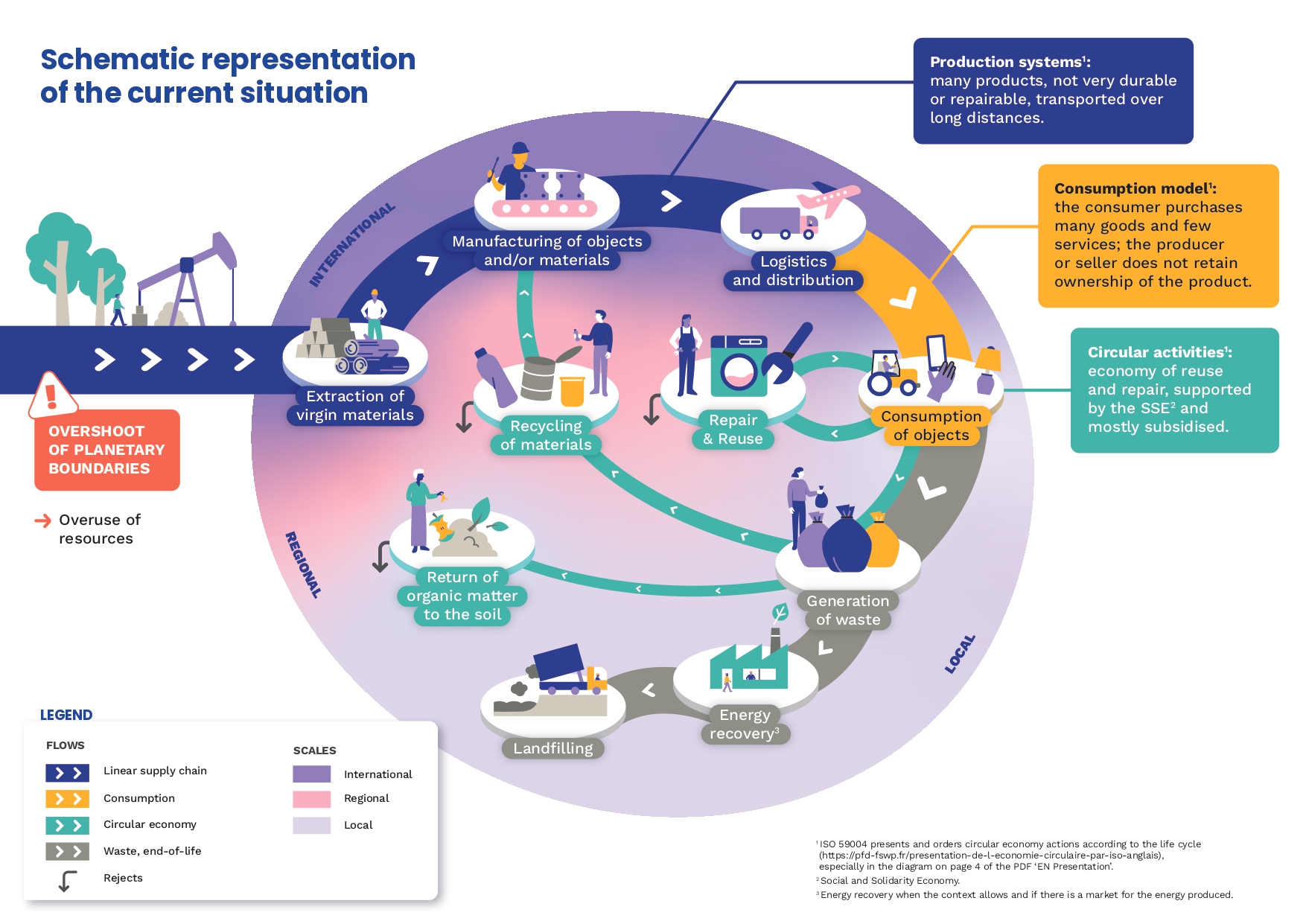
The current mostly linear model
Today, our production methods remain dominated by the manufacturing of products that are not very durable or repairable. Our economic models are based on individual ownership of goods and unsustainable consumption. The reuse and repair economy exists but remains largely confined to the social and solidarity economy. These production and consumption models maintain strong pressure on natural resources, ecosystems and the climate, and contribute to exceeding planetary boundaries.
2050 horizon: an economy compatible with the “3-D” vision
In a 2050 scenario compatible with vision set forth by the FSWP - for a future where economic growth is decoupled from environmental bads, and therefore decontaminated and decarbonised -, virgin material flows are drastically reduced. Fewer products are manufactured, but they are more durable, repairable and better designed. The economy is organised around models of functionality or performance, in which the producer or lessor retains ownership of the good or responsibility for its end of life. Reuse, repair, refurbishment and remanufacturing activities are no longer marginal: they form a structural part of the economic fabric, primarily at local level, with stable business models and strong social and professional recognition.
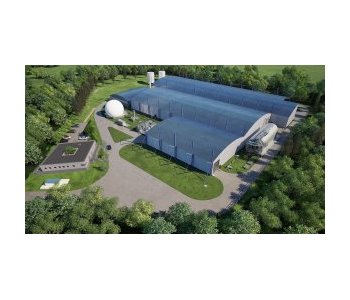
Waste management systems also evolve. Worldwide, all waste is managed in accordance with Environmentally Sound Management (ESM) as defined by the Basel Convention. Very little waste remains to be treated: the return to soil of organic materials is secured through high-quality upstream sorting by users and suitable packaging; material recycling relies on value chains capable of providing regular, standardised, traceable flows; and energy recovery focuses on non-recyclable volumes.
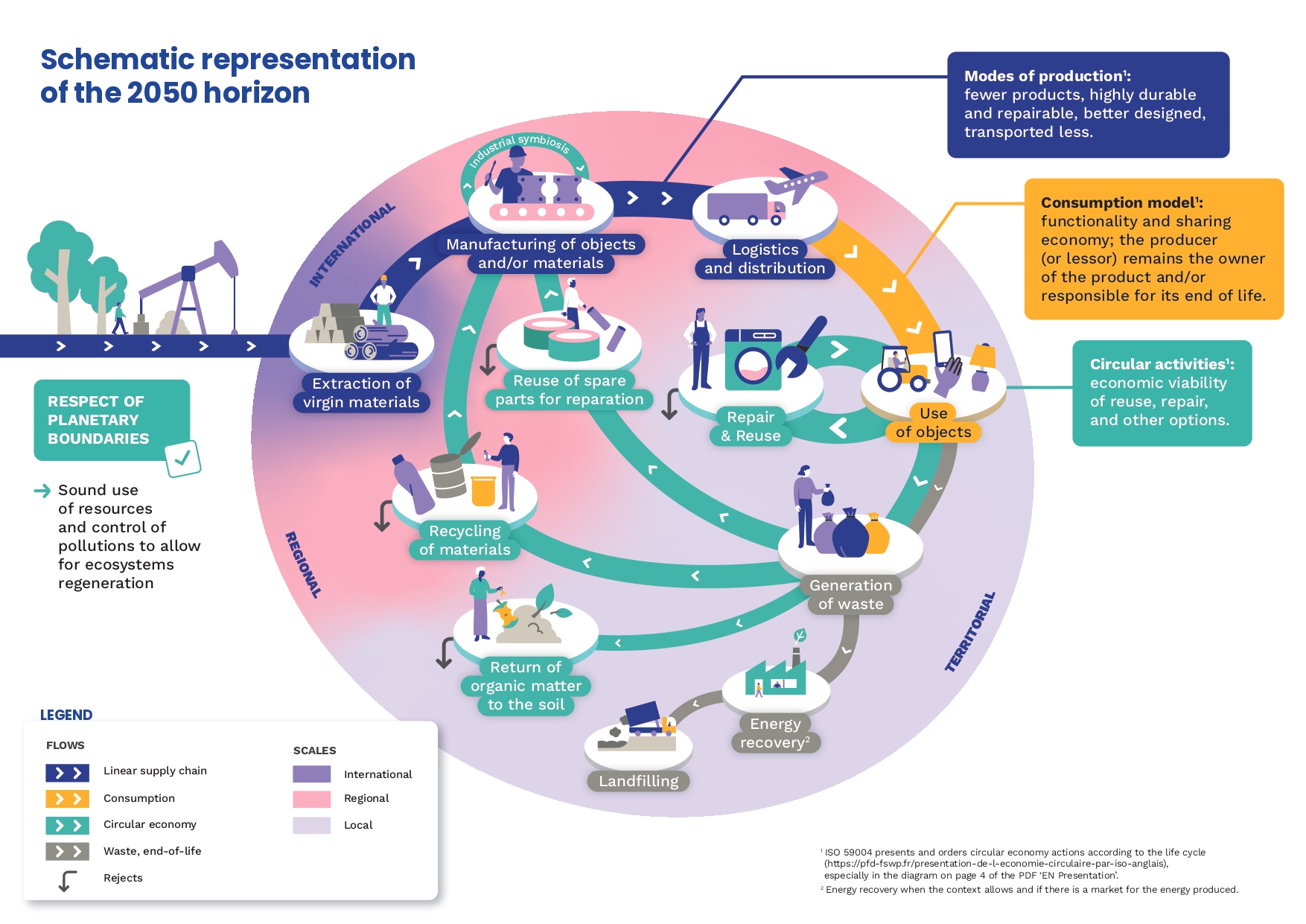
The circular economy would therefore become a means to reduce environmental impacts and strengthen economic resilience, in service of a truly decarbonised, depolluted and decoupled future—one in which health, the well-being of living systems, human dignity and access to decent living conditions are central.
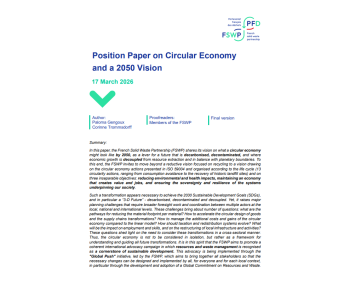
Read the full Position Paper about Circular Economy and a 2050 Vision :

See the complete circular economy schematic :
*Kirchherr, J. et al. (2017). Conceptualizing the circular economy: An analysis of 114 definitions. Resources, Conservation & Recycling [online], No. 127. p. 224. [Last consulted 13 March 2026]. Available at: https://doi.org/10.1016/j.resconrec.2017.09.005.